How it works
How Solarable works.
Three tools, one honest answer — and the method behind every number. Enter an address and we open three views of your roof, combine them into a Solarable Score, and hand you the figures before you speak to a single installer. No account, no sales call — just the data to walk into that conversation on equal terms.
The point
Walk in already knowing your numbers.
The usual way to buy solar is to ring a company and let their salesperson tell you what your roof can do. Solarable turns that around. Before you speak to anyone, you already know which way your roof faces, how much useful sun it gets, what a realistic year of savings looks like, and which MCS-certified installers actually cover your postcode.
So when a quote lands, you can:
- Tell whether the system size and savings actually fit your roof
- Ask sharper questions instead of taking figures on trust
- Compare quotes against an independent baseline
- Spot a number that looks too good — or too cautious
Solarable doesn't replace the installer's survey — it means you arrive at it informed, not cold.
Three tools
What you can do.
Check my roof
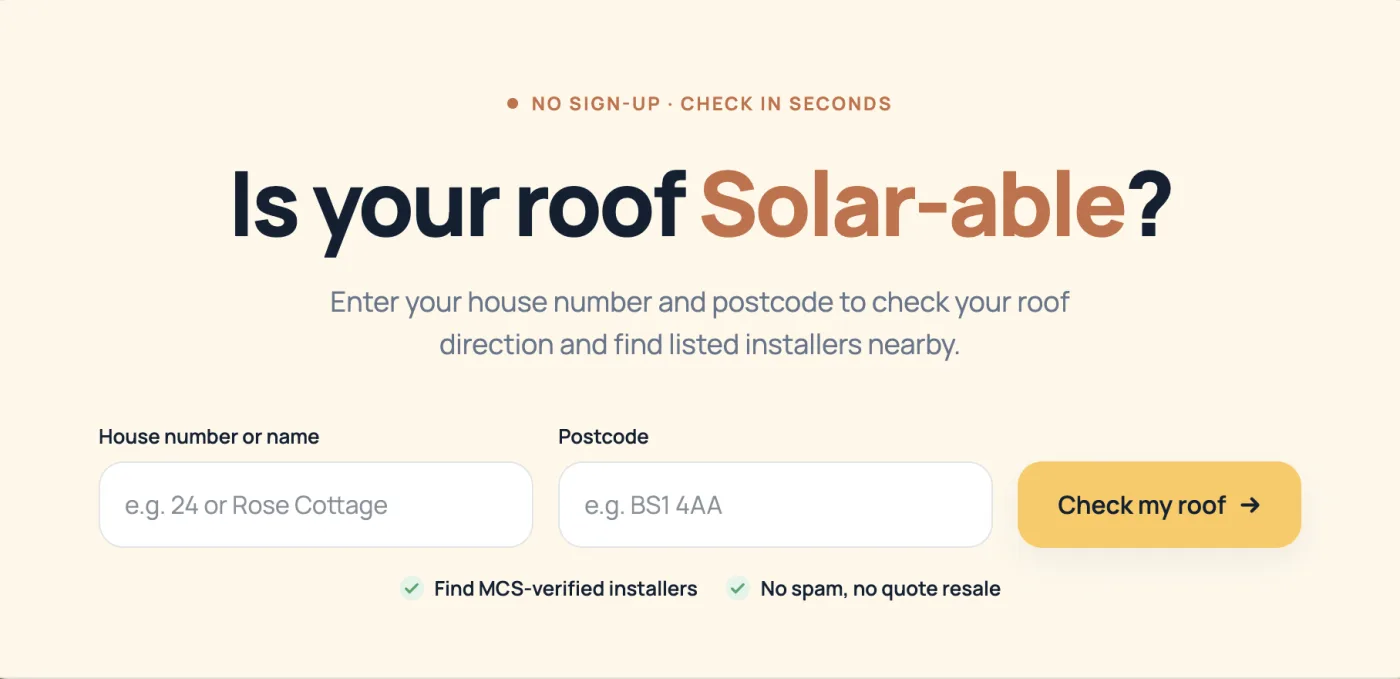
Enter your address; get a Solarable Report with your roof direction, a Solarable Score, and listed installers covering your area.
Check my roof →
Estimate my savings
A range-based calculator for annual benefit and payback, with battery, property size, and roof-direction inputs.
Open the calculator →
Find listed installers
Browse MCS-certified installers covering your postcode. We verify every certificate before a listing goes live; featured listings are clearly marked as paid placement.
Browse the directory →
The method
How the roof check works.
From a house number and postcode we find your building and read its roof — no installer phone call, no satellite guesswork.
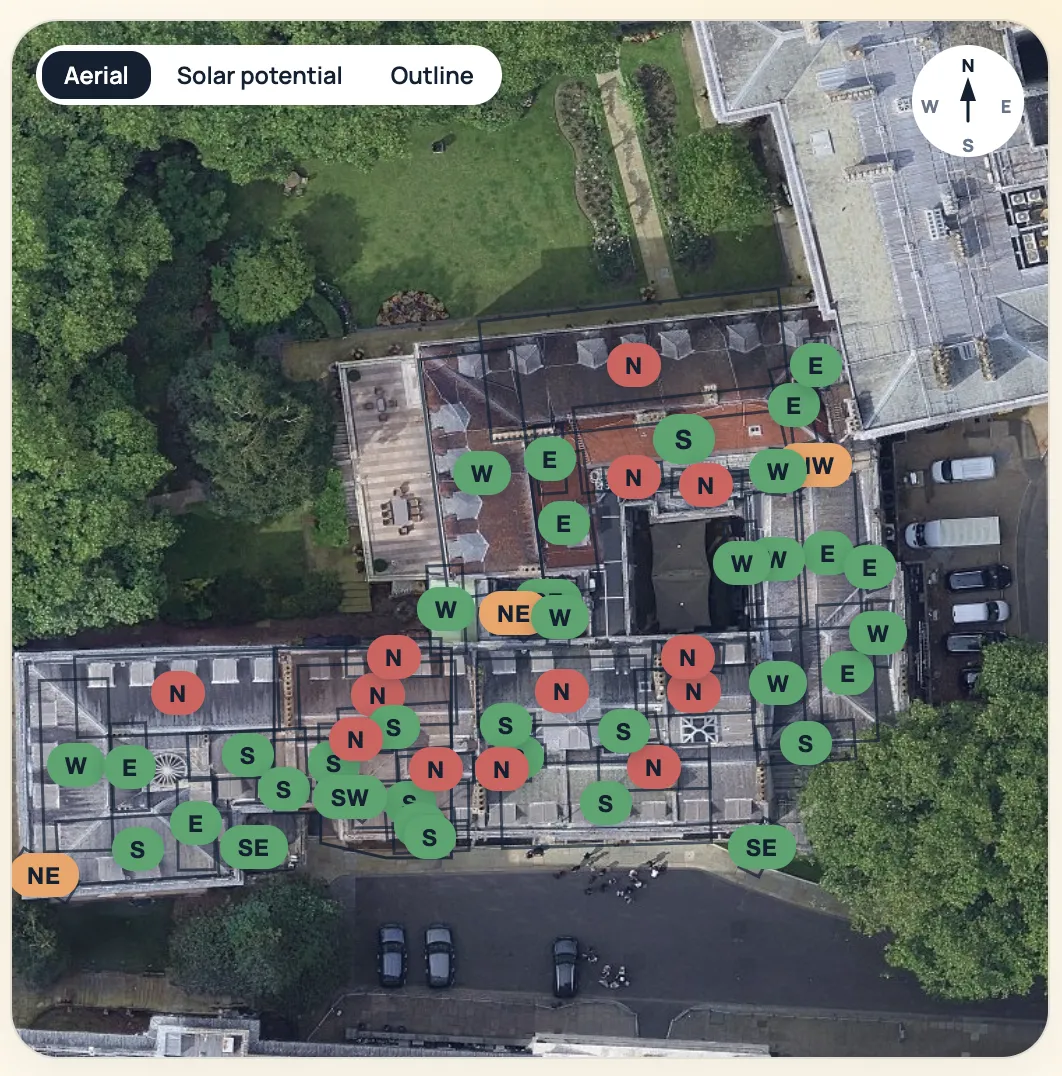
- We locate your home. Your address resolves to a specific building and we draw its footprint from mapping data — your roof, not your street.
- We read each roof face. We work out which way every face points and how much usable sun it catches across the year, on an eight-point compass.
- We show a confidence signal. Simple, rectangular roofs read clearly; complex shapes are flagged as lower confidence rather than dressed up as certainty.
- You confirm or correct it. One tap flips the direction if we read it wrong — your answer feeds the score.
The method
How the Solarable Score works.
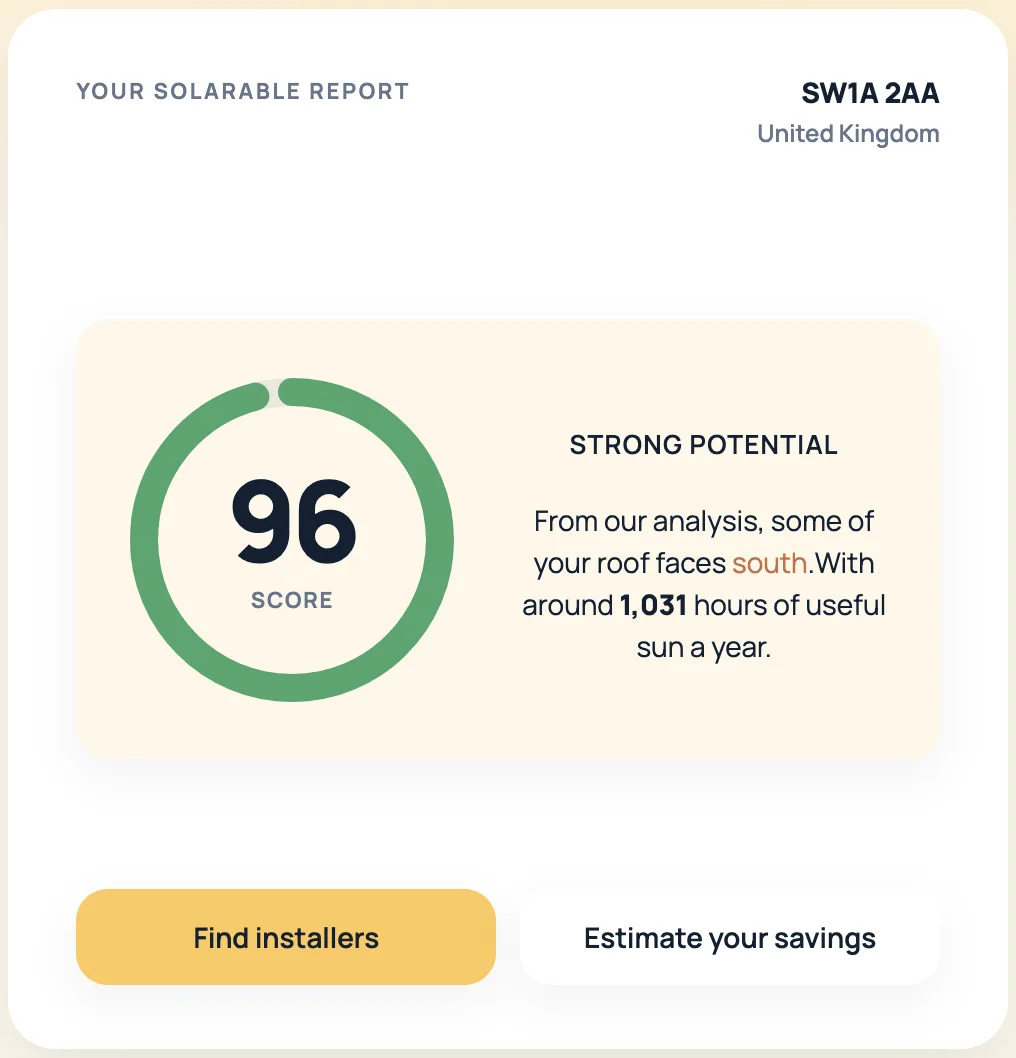
The score combines three things: which way your roof faces, how confident we are in that reading, and how much usable sunlight your region gets across the year. It lands on a 0–100 scale, mapped to one of five bands — each with a plain-English label, never a colour on its own.
- Strong A roof facing close to south, with good confidence. A strong candidate worth a survey.
- Good South-east or south-west, or south with a little uncertainty. Usually well worth pursuing.
- Possible East or west-facing roofs. Often still worthwhile, frequently better with a battery.
- May be difficult North-leaning or low-confidence roofs. A survey may find a better face on the same home.
- Not enough information When we can't read the roof confidently, we say so rather than guess a number.
The score tells you whether a roof is worth a closer look — not a guaranteed outcome. The survey is where suitability is confirmed.
The method
How the savings calculator works.
You give us four things; we give you honest ranges, never a single false-precision number on a stranger's house.
What you tell us
- Roof direction (or "not sure")
- Property size — terrace, semi, or detached
- How much electricity you use in the daytime
- Whether you'd add a battery
What you get back
- Estimated annual generation, as a range
- Annual benefit in £ — bill savings plus export
- Indicative system cost
- A payback range in years
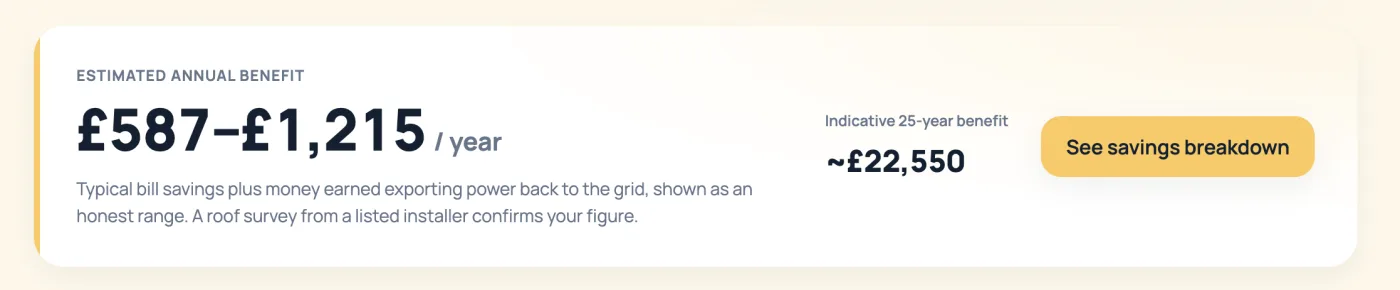
Figures use 2026 UK assumptions and your region's sunlight. A south-facing UK roof typically pays back in 8–12 years; east or west adds a year or two.
Honest limits
What we can't see.
- Shading from chimneys, neighbouring roofs, and trees — it can cut output more than you'd expect on smaller roofs.
- Planning constraints. Listed buildings and conservation areas can need permission. A local installer will know.
- Roof condition. Older roofs sometimes need work before panels go on; the survey checks the structure.
That's why we always recommend an installer survey before you commit. Solarable's estimates help you decide whether that survey is worth booking — they don't replace it.
The directory
A directory, not a lead machine.
When your postcode matches an installer's service area, their listing appears beneath your report and your calculator results. The difference is in how the directory is run:
- Every installer is MCS-certified. We check their certificate against the MCS register before they go live — here's how we vet installers.
- Featured listings are labelled as paid placement. You always know what's a paid position and what isn't.
- You choose how you're contacted. Browse and contact installers yourself, or ask for up to three quotes from your report and we introduce you to that many, no more.
For installers
Are you a UK solar installer? Claim your free profile.
We've already listed installers across the UK — claim yours, or add your company in the postcode districts you cover. A flat annual listing — homeowners find and contact you directly.
Try the tools
Start here.
Check your roof
Address-based roof check. Postcode in, Solarable Report out.
Open →
Solar savings calculator
Annual benefit and payback in honest UK ranges.
Open →
Browse listed installers
Solar installers covering UK postcodes.
Open →
Can I get solar panels?
Top-of-funnel suitability check for UK homes.
Open →